You look in the mirror, spot a line, and wonder which treatment will actually help. Botox and dermal fillers get mentioned in the same breath, but they do very different jobs. If expression lines are your main concern, you may be wondering whether Botox is right for you.
Botox relaxes the muscles that create lines when you move your face, while dermal fillers add volume back to areas that have flattened or hollowed out. So if your forehead creases when you raise your eyebrows, Botox may help create a younger-looking face by softening those movement-related lines. If your cheeks look deflated or your smile lines remain even when your face is at rest, fillers work differently by restoring lost volume.
Both are injectable cosmetic treatments that people choose when they want to address signs of facial aging without surgery. Botox is sometimes described as a lunch-hour wrinkle remedy because treatment can typically fit into a relatively short appointment. Below, you'll learn how Botox vs dermal fillers compare, including which concerns each addresses, how long results may last, and what to discuss during your consultation.
Key Takeaways
- Lines that appear when you move your face usually call for Botox, while sunken or flat areas usually call for fillers.
- Botox results typically fade in three to four months, and most fillers last longer, depending on the product and placement.
- Many people combine both treatments, and a consultation with a trained provider helps you pick the safest option for your goals.
The Quick Test: Movement Lines or Volume Changes?
Here's a simple way to figure out what's going on with your face: stand in front of a mirror and watch what happens when you stop making expressions. Lines that fade when your face relaxes come from muscle movement, while lines and hollows that stay put usually point to volume loss.
How to Spot Dynamic Wrinkles
Dynamic wrinkles show up when your face moves. Raise your eyebrows, squint, or smile big, and watch what appears.
The classic spots are your forehead, the "11s" between your brows, and the crow's feet at the corners of your eyes. These are your expression lines, and they're caused by the same muscles firing over and over for decades.
Now relax your face completely. If those lines smooth out or nearly disappear, they're dynamic lines.
This is the group that responds to Botox, since the treatment temporarily limits movement in the muscles doing the folding. Fine lines that only show during facial expressions fall into this same bucket.
How to Recognize Static Wrinkles and Folds
Now do the opposite test. Keep your face totally still and neutral, then look again.
Anything still visible is a static wrinkle or fold. Common examples include the nasolabial folds running from your nose to the corners of your mouth, flattened cheeks, and hollows under your eyes.
These usually come from volume loss, the fat pads, collagen, and bone support in your face change with age, so the skin has less structure holding it up.
Fillers are built for this. They add volume and restore support where the face has lost it, which smooths folds and rebuilds contour.
A quick way to sort it:
| What you see | Likely cause | Usual fix |
|---|---|---|
| Line only when you move | Muscle movement | Botox |
| Line at rest | Volume loss, skin changes | Filler |
| Hollow cheeks or temples | Volume loss | Filler |
Why One Concern Can Have More Than One Cause
Faces don't always age in just one way. Facial aging can involve both muscle activity and structural changes, which is why one treatment may not address every concern. For more noticeable sagging or structural changes, a face/neck lift may also be worth discussing as a different treatment approach.
Take deep frown lines. Repeated muscle movement can create them, but once those lines remain visible at rest, they have become static too. If concerns about looking unnatural are holding you back from treating expression lines, understanding common Botox myths can help you separate misconceptions from what the treatment is actually designed to do.
The same applies to the lower face. Nasolabial folds are largely related to volume and structural changes, while changes in the cheeks can make them appear deeper. That's why combination plans are sometimes used, with Botox addressing muscle-driven lines and filler restoring volume where needed.
What Botox Treats Best
Botox works on lines that show up when your face moves, not on lost volume. It is a good match for forehead lines, frown lines, and crow's feet, and it also has medical uses like easing jaw clenching and reducing sweating.
How Botulinum Toxin Relaxes Targeted Muscles
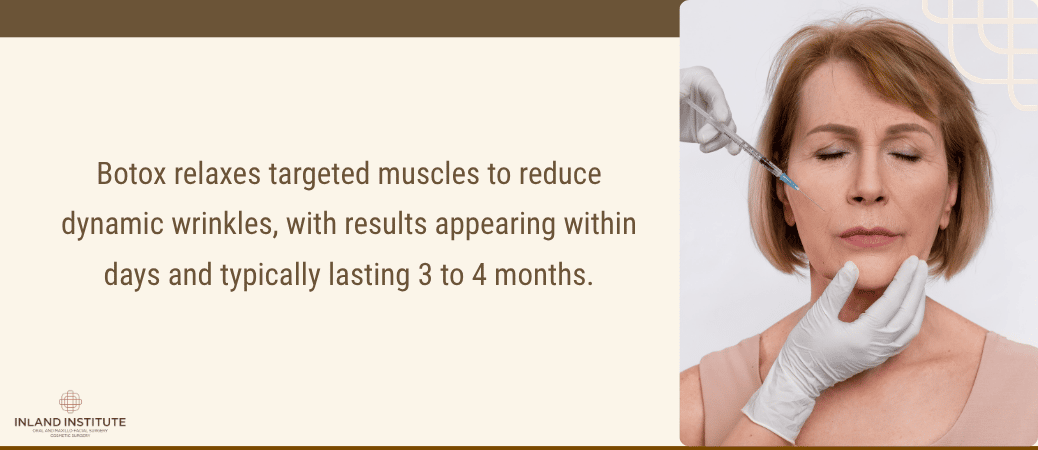
Botox is a brand of botulinum toxin type A, a type of injectable called a neuromodulator.
When it's placed into a specific muscle, it blocks the signal that tells that muscle to squeeze. The muscle takes a break, so the skin above it stops creasing as much.
That's why Botox helps dynamic wrinkles, the ones that deepen when you frown, squint, or raise your brows. It does not add volume or plump anything up.
Results build slowly. Most people see softening in 3 to 5 days, with the full effect around two weeks. It usually lasts about 3 to 4 months, depending on your dose, muscle strength, and how fast your body processes it.
Common Areas for Botox Treatment
Most cosmetic Botox injections go into the upper face, where muscle movement drives the lines.
| Area | What it treats |
|---|---|
| Forehead | Horizontal forehead lines from raising your brows |
| Between the brows | Frown lines, sometimes called "11s" |
| Outer eyes | Crow's feet from smiling and squinting |
| Nose | Bunny lines across the bridge |
| Upper lip | A lip flip, which rolls the lip edge slightly outward |
| Neck | Vertical platysma bands |
| Jaw | Masseter muscle for a softer lower-face shape |
Downtime is usually minimal. You might get a little redness or a small bruise at the injection points.
One thing to know: if the product spreads to nearby muscles, you can get temporary brow heaviness or ptosis (a droopy eyelid). It fades as the effect wears off, but skilled placement lowers the risk. Since Botox targets movement, it's often paired with dermal fillers for volume loss when both concerns are present.
Uses Beyond Cosmetic Wrinkle Smoothing
Botox isn't only for wrinkles.
Masseter Botox is often discussed for teeth grinding, jaw clenching, and TMJ-related muscle tightness. Relaxing that chewing muscle can reduce clenching force. Keep in mind this is considered an off-label use for jaw tension.
Botulinum toxin is also used for hyperhidrosis, or excessive sweating, most often in the underarms. It blocks the nerve signals that switch on sweat glands in the treated area.
Other medical uses include chronic migraine, muscle spasms, and overactive bladder. These treatments use different dosing and injection patterns than cosmetic work, so ask a qualified provider what fits your situation.
What Dermal Fillers Treat Best
Dermal fillers work by adding volume under your skin, so they shine when the problem is lost fullness rather than muscle movement. Think sunken cheeks, deep folds around your mouth, thin lips, and a jawline that has softened over time.
Restoring Lost Support and Facial Volume
Your face loses fat, bone density, and collagen as you age. That's why cheeks flatten and the skin below them starts to sag.
Fillers act like liquid implants injected into your skin to rebuild that missing support. Cheek volume restoration is one of the most common goals, and lifting the cheeks often improves the area below them too.
Most fillers use hyaluronic acid, a substance your body already makes. Others use materials like calcium hydroxylapatite or polymethylmethacrylate, which last longer but can't be dissolved as easily.
Some providers also use your own fat, taken from another part of your body. That method is called autologous fat grafting.
Smoothing Folds and Hollow Areas
Static wrinkles are the lines you see when your face is completely relaxed. These come from thinning skin and lost volume, not from muscle activity, so they need a different fix than Botox offers.
Common areas treated with filler include:
- Nasolabial folds: The smile lines running from your nose to the corners of your mouth
- Marionette lines: The creases from your mouth corners down toward your chin
- Under-eye hollows: The shadowy dip between your lower lid and cheek
- Temple hollowing: The sunken area at the sides of your forehead
Deep folds sometimes need both treatments. In those cases, a neuromodulator relaxes the muscle underneath while filler smooths the line at rest.
Enhancing Lips, Cheeks, and the Jawline
Fillers aren't just for aging concerns. Plenty of people use them to change facial contours they've never loved.
Lip filler adds volume, improves shape, and can balance an upper and lower lip that don't match. A small amount often makes a noticeable difference, so you don't need to start big.
Jawline definition is another popular request. Filler placed along the jaw and chin creates a sharper edge and can improve the profile of the lower face.
Cheekbones can be built up the same way. Some providers also offer hand rejuvenation, since the backs of your hands lose volume and show veins and tendons more clearly over time.
Results, Longevity, Cost, and Maintenance
The two treatments work on different timelines: filler adds volume you can see the same day, while Botox takes several days to relax the muscle. Your budget planning also looks different, since Botox is billed per unit and filler is billed per syringe.
When Results Appear and How They Settle
Filler results show up right away. You walk out with more volume in your lips, cheeks, or under-eyes, though some of what you see at first is swelling.
Botox results take longer. Most people notice softening in 3 to 5 days, with the full effect at about 10 to 14 days. That's why injectors usually schedule a check-in around the two-week mark.
Mild side effects are common with both injectable treatments:
- Most noticeable swelling after lip filler, often 24 to 72 hours
- Bruising can last a few days to a week
- Redness or small bumps at the injection points
- Tenderness when you press on the area
Filler needs a couple of weeks to settle before you judge it. If you want natural-looking results, avoid booking a big event within two weeks of either appointment.
How Long Each Injectable Typically Lasts
Botox is the shortest-lived option. Fillers vary a lot depending on the material and where it goes.
| Treatment | Type | Typical duration |
|---|---|---|
| Botox, Dysport, Xeomin | Neuromodulator | 3–6 months |
| Lip filler (HA) | Hyaluronic acid | 6–12 months |
| Cheek filler (HA) | Hyaluronic acid | 12–24 months |
| Radiesse | Calcium hydroxylapatite | 12–18 months |
| Sculptra | Collagen stimulator | 2–5 years |
| Bellafill | PMMA, semi-permanent | 5+ years |
Areas that move constantly break product down faster, which is why lip filler sits at the short end of the filler range.
Your metabolism, sun exposure, and how much product was used all shift these numbers. Treat them as ranges, not promises.
What Affects Treatment Cost and Long-Term Budgeting
Botox is priced per unit. Filler is priced per syringe, and cheeks or jawline frequently need two or more.
A few things move your price:
- Your city. Metros run noticeably higher than smaller markets.
- Injector credentials. Experienced, board-certified providers often charge more.
- Product choice. Longer-lasting fillers cost more per syringe.
- Number of areas treated.
Think in cost per year, not per visit. Maintenance treatments are part of the deal with both. Always ask for an itemized quote, units for Botox, syringe count for filler, before you book, since the two are billed differently and aren't directly comparable.
Filler Types, Reversibility, and Safety
Not all dermal fillers work the same way. Some add volume right away and can be dissolved if you don't like the results, while others build collagen slowly over months and stay in place until your body breaks them down.
Hyaluronic Acid Fillers and Reversal Options
Hyaluronic acid fillers are the most common type you'll be offered. Brands like Juvéderm, Restylane, and Voluma use a gel form of hyaluronic acid, a sugar molecule your body already makes to hold water in your skin.
The big advantage is reversibility. If you get too much product, if it settles unevenly, or if you simply change your mind, your injector can dissolve HA filler with an enzyme called hyaluronidase.
That safety net matters. It also means HA fillers are a reasonable starting point if this is your first time.
Most HA fillers last 6 to 18 months, depending on the product and where it goes. Lips break down filler faster than cheeks because they move constantly.
Collagen-Stimulating and Longer-Lasting Fillers
Some fillers don't just fill space. They encourage your body to make its own collagen, which helps counter the collagen breakdown that comes with age.
| Filler | Main Ingredient | What It Does |
|---|---|---|
| Sculptra | Poly-L-lactic acid | Builds collagen gradually over several months |
| Radiesse | Calcium hydroxylapatite | Adds volume now, stimulates collagen after |
| Bellafill | Polymethylmethacrylate (PMMA) | Semi-permanent support with collagen gel |
These options often suit mature skin or larger areas like temples and cheeks. Sculptra results build slowly, so you'll usually need a series of sessions.
The tradeoff is simple: these fillers cannot be dissolved with hyaluronidase. If you're unhappy, you wait it out. That's why many injectors suggest starting with HA products.
Risks That Require an Expert Injector
Fillers are medical treatments, not spa services. The most serious risk is vascular occlusion, which happens when filler blocks a blood vessel and cuts off blood flow to skin or, rarely, the eye.
Other possible problems include infection, lumps, allergic reaction, and scarring. Bruising and swelling are common and usually fade within a week or two.
Your best protection is who holds the syringe. At Inland Institute Oral & Maxillofacial Surgery, injectable treatments are planned with careful attention to facial anatomy, treatment goals, and safe placement to help achieve natural-looking results.
Ask a few direct questions before you book:
- How many of these treatments do you perform each month?
- Do you use FDA-approved fillers, and which brand?
- Do you keep hyaluronidase on site for emergencies?
A good injector will answer without hesitation.
When a Combined Plan Makes Sense
Aging shows up in more than one way at once, so many people get better results when Botox and dermal fillers are used together in the same plan. A good consultation, honest photos, and an injector who knows facial anatomy help you decide what's worth treating and what can wait.
Pairing Muscle Relaxation With Volume Restoration

Botox and dermal fillers fix two different problems. Botox softens the lines that show up when you move your face. Fillers add back the volume you've lost in your cheeks, temples, or under your eyes.
Treating only one can leave the job half done. If your forehead is smooth but your midface has flattened, your face may still look tired.
A common pairing looks like this:
| Concern | What's usually used |
|---|---|
| Frown lines between the brows | Botox |
| Crow's feet | Botox |
| Flat or hollow cheeks | Filler |
| Nose-to-mouth folds | Filler |
| Weak chin or soft jawline | Filler |
When several areas are treated in one visit, it's sometimes called a liquid facelift. Doing both at once is common practice, and many providers say combining them can lead to more natural-looking results than one treatment alone.
What Happens During a Personalized Consultation
Your injector should look at your whole face, not just the line you point out. Expect to be asked to frown, smile, and raise your brows so they can see which wrinkles come from movement and which stay put at rest.
You'll also go over your health history. Blood thinners and drugs like ibuprofen can raise your chance of bruising, so mention everything you take.
Then comes the mapping part. A thoughtful plan made upfront decides which areas get muscle relaxation, which get volume, and whether anything should be spaced out over separate visits.
Dr. David Gilbert evaluates your facial anatomy, muscle movement, and areas of volume loss before recommending an injectable treatment plan. This individualized approach helps determine where Botox, dermal fillers, or a combination of both may best address your concerns while keeping the results balanced and natural-looking.
Using Before-and-After Photos to Set Realistic Goals
Ask to see reviews of your provider, particularly photos and not stock images from a brochure. Look for people whose face shape, age, and concerns are close to yours.
Pay attention to the details. Is the lighting the same in both photos? Is the person making the same expression? Small changes in angle or smile can make results look bigger than they were.
Your own photos matter too. Most clinics take baseline pictures at your first visit, which gives you something honest to compare against later.
These images also help set expectations. Facial rejuvenation with injectables can soften lines and restore fullness, but it won't lift loose skin or change your bone structure.
Frequently Asked Questions
Botox relaxes muscles that create lines when you move your face, while fillers add volume back where it has been lost. Below are answers about cost, safety, and which treatment matches common concerns like forehead lines, thin lips, and a soft jawline.
What's the difference between Botox and dermal fillers?
Botox is a purified protein that temporarily stops a muscle from contracting. When the muscle relaxes, the crease it was folding into softens.
Dermal fillers are gels injected under your skin. They add volume beneath the skin rather than affecting muscles or nerves.
There's also a difference in how long they last. Botox usually holds for about 3 to 4 months, while fillers can last anywhere from 6 months to several years depending on the product.
How do I know whether Botox or fillers are right for my concerns?
Try this simple test at home. Look in the mirror with a relaxed face, then make an expression like frowning or smiling.
If the line only shows up when you move, Botox is usually the better fit. If the line or hollow is there even when your face is still, filler is more likely what you need.
Many people end up needing both. Botox tends to handle the upper face while fillers work on mid-face and lower-face volume loss, deep folds, and lips.
Is Botox or dermal filler safer?
Both are considered safe when a licensed, trained injector performs the treatment. Neither one is risk-free.
With Botox, common side effects include mild bruising, headache, and occasionally a drooping eyelid or brow. Rare problems happen if the product spreads past the treatment area.
Fillers can cause bruising, swelling, lumps, or redness that usually clears within 1 to 2 weeks. The most serious risk is filler entering a blood vessel, which can damage tissue.
One practical note: hyaluronic acid fillers can be dissolved with an enzyme if you don't like the result. Botox can't be reversed, but it does wear off.
How much do Botox and dermal fillers typically cost?
Botox pricing usually ranges from around $300 to nearly $1,400+ per treatment, depending on how many units you need and where you live.
Fillers typically run $600 to $1,000+per syringe. Some areas, like cheeks or jawline, often need more than one syringe.
Botox costs less upfront, but you'll repeat it three or four times a year. Filler costs more per visit and lasts longer, so the yearly math can end up closer than you'd expect.
Should I choose Botox or filler for forehead lines and wrinkles?
For horizontal forehead lines that appear when you raise your eyebrows, Botox is the standard choice. It's FDA approved for forehead lines, frown lines between the brows, and crow's feet.
Deep forehead creases that stay visible at rest are trickier. Some injectors combine Botox with a small amount of filler placed in the crease, but this area carries more risk than others.
If your forehead lines are mild, starting with Botox alone makes sense. You can always add more later.
Can Botox or fillers help with under-eye hollows, lips, or jawline definition?
These three concerns are almost always filler territory, not Botox.
Under-eye hollows respond to a small amount of hyaluronic acid filler placed carefully in the tear trough. This area is delicate, so experience matters a lot here.
Lips need filler to gain fullness or definition. Botox is sometimes used in a "lip flip" to slightly roll the upper lip outward, but it doesn't add any actual volume.
Jawline definition typically calls for a firmer filler along the jaw to sharpen the edge. Botox plays a supporting role here by slimming bulky chewing muscles in some people, and combining fillers for contour with Botox for muscle relaxation is common for the lower face.