A cracked tooth can feel scary, especially when you're not sure if you'll get to keep it. The good news is that many cracked teeth can be repaired.
Whether you save or extract a tooth comes down to how deep the crack goes and how much healthy tooth is left, since a crack that stays above the nerve usually just needs a crown, while one that splits the root normally calls for removal.
Your dentist also looks at the root's condition and what makes sense for your long-term oral health, not just today's pain. That's why not all cracked teeth need to be pulled.
Below, you'll learn about the different types of cracks, the tools dentists use to measure crack depth, and when root canal therapy or cracked tooth extraction makes more sense. You'll also see how each choice affects your cost and recovery time, plus what your options are if the tooth does need to come out.
Key Takeaways
- Crack depth and remaining tooth structure decide whether your tooth can be saved.
- A microscope, 3D imaging, and bite testing help your dentist pinpoint the damage before treatment starts.
- Shallow cracks often need only a crown, while split teeth and root fractures usually require extraction and a replacement plan.
The First Question: Is the Tooth Saveable?
Before your dentist talks about crowns, root canals, or pulling anything, they need to answer one question: can this tooth actually be rebuilt and used for years to come?
That answer comes down to how much solid tooth is left, how far the damage travels below the gumline, and how healthy the root and surrounding bone are.
How Much Healthy Tooth Structure Remains
A crown needs something to hold onto. If most of the chewing surface is gone and only thin walls of enamel are left, there may not be enough healthy tooth structure to support a restoration.
Dentists often think of this as a savability scorecard, can the tooth be rebuilt, will the repair last, and does the plan fit your situation?
Here's a rough guide to what your dentist is looking at:
| What's left | Typical outlook |
|---|---|
| Broken cusp, walls intact | Crown usually works well |
| One or two walls remaining | Post, buildup, and crown may be needed |
| Damage below the gumline on multiple sides | Saving the tooth gets much harder |
| Tooth split into two pieces | A split tooth cannot be restored |
More solid tooth means more options, and usually a lower cost.
Whether the Damage Extends Below the Gumline
A crack that stops at the chewing surface is very different from one that runs down under your gums.
Why does this matter? Your dentist needs a clean, dry edge of tooth to seal a crown against. When the break sits below the gumline, saliva, bacteria, and gum tissue get in the way.
Sometimes there's a workaround. A small gum trim, or in some cases a procedure to move the tooth up slightly, can expose enough edge to work with.
But when a crack travels deep along the root, the situation changes. A vertical root fracture creates a permanent path for bacteria and can't be repaired, which is why those teeth are almost always removed.
Why Root Condition and Bone Support Matter
Even a perfectly restorable crown is only as good as what's holding it in place.
Your dentist checks the bone around the root with X-rays or 3D imaging. If gum disease has damaged the tissues and bone supporting the tooth, periodontal treatment may be needed to address the underlying problem. The amount of healthy bone remaining also helps determine whether the cracked tooth can be saved.
Bone loss after a missing tooth is also an important consideration when planning what happens if a damaged tooth cannot be saved. Your dentist will look at the root itself, including previous root canal problems or decay that extends deep into the tooth.
This helps determine whether repairing the tooth offers a good long-term outlook or whether extraction and replacement may provide a more predictable solution.
What Type of Crack Is Present?
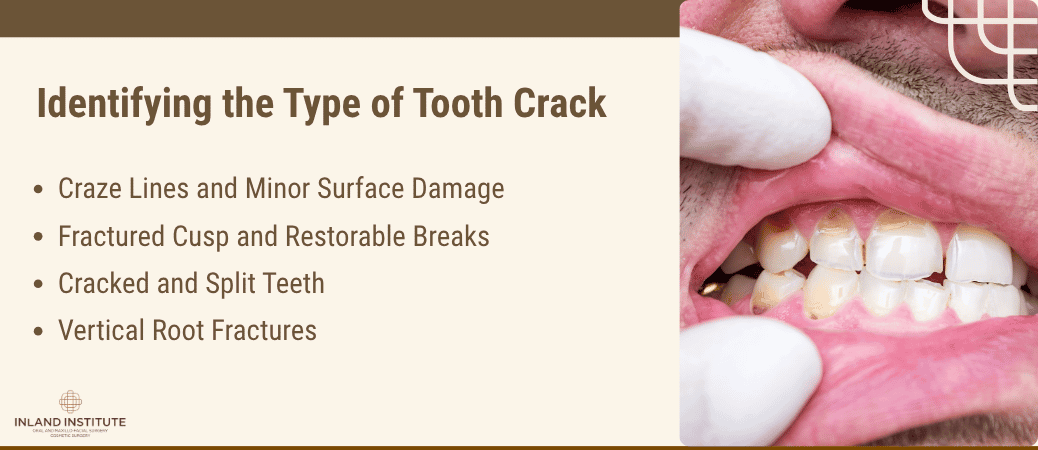
Not every crack means the same thing for your tooth. The American Association of Endodontists sorts cracks into five main types of tooth fractures, and each one comes with its own outlook, from harmless lines in the enamel to breaks that end in extraction.
Here's a quick look at how the five types compare:
| Crack Type | Usually Saved? | Common Treatment |
|---|---|---|
| Craze lines | Yes | None needed |
| Fractured cusp | Usually | Filling, onlay, or crown |
| Cracked tooth | Sometimes | Crown, sometimes root canal |
| Split tooth | Rarely | Extraction |
| Vertical root fracture | Almost never | Extraction |
Craze Lines and Minor Surface Damage
Craze lines are tiny cracks that stay inside the enamel, the hard outer shell of your tooth. They don't reach the dentin underneath, so they don't weaken the tooth.
Almost everyone has them. They show up most often on front teeth as thin vertical lines, and your dentist can see them clearly by shining a light through the tooth.
Craze lines don't hurt and don't need repair. If they've picked up stain and bother you, whitening or bonding can help for looks alone.
Grinding your teeth can make them more noticeable over time. A nightguard is a simple way to cut down on that pressure.
Fractured Cusp and Restorable Breaks
A fractured cusp is a break in one of the pointed chewing corners of your tooth. It often happens around a large old filling that left the cusp thin and unsupported.
Lower molars tend to break on the tongue side, upper molars on the cheek side.
You may feel a sharp twinge when you bite down and again when you let go. Once the loose piece comes off, that pain usually stops.
The good news: this type rarely reaches the nerve, so the outlook for keeping the tooth is good. Depending on how much solid tooth is left, your dentist may place a filling, an onlay, or a full crown to protect what remains.
Cracked and Split Teeth
A cracked tooth has a crack that starts at the chewing surface and runs down toward the root, usually front to back. The tooth is still in one piece, but the crack can spread.
If it reaches the pulp, you may need a root canal along with a crown. A crown holds the tooth together and lowers the chance the crack grows.
A split tooth is what a cracked tooth becomes when the crack goes all the way through. The pieces separate, and there's no way to put them back together.
Most split teeth need to come out. With an upper molar, your dentist can sometimes remove just the split root and save the rest of the tooth.
Vertical Root Fractures
A vertical root fracture starts down in the root and moves upward, so you may not see or feel anything at first. Many are found on an X-ray during a routine visit.
Nearly all of them happen in teeth that already had a root canal. Signs include a narrow, deep pocket along one spot on the root or a small drainage opening in the gum.
The outlook here is poor. These teeth are almost always extracted, since there's no reliable way to seal a crack that deep.
Prevention matters more than repair. Keeping as much dentin as possible during a root canal, skipping posts when they aren't needed, and adding a crown afterward all help protect the root.
How Dentists Diagnose the Damage
Before your dentist can tell you whether a tooth can be saved or needs to come out, they have to find the crack and figure out how deep it goes. That takes a mix of your symptom history, a hands-on exam, imaging, and sometimes a second opinion from a specialist.
Symptoms That Point to a Cracked Tooth
Cracked tooth pain can be confusing because it comes and goes. You may not even be able to point to the right tooth.
Here are the clues dentists listen for:
- Sharp pain when you let go of a bite, often more than when you bite down
- A quick zing from cold or hot food that fades fast instead of lingering
- Pain on one side only, and sometimes only in one chewing position
- Symptoms that started slowly and keep getting a little worse
- A large old filling in the tooth that hurts
Swelling, a bad taste, or a constant throb are different signals. Those often mean bacteria have reached the pulp or the root, which changes the treatment plan.
Clinical Exams and Bite Testing
Your dentist starts by looking, but plain light only shows part of the story. A crack on the surface can stop above the nerve or run much deeper.
That's why a bite test is so useful. You bite down on a small plastic tool or wedge placed on one cusp at a time, then release. If your sharp pain shows up on release, that cusp is likely the cracked one.
Dentists also use other quick checks:
| Test | What it tells you |
|---|---|
| Bite testing | Which cusp or spot the crack involves |
| Cold test | Whether the nerve is healthy, irritated, or dead |
| Tapping the tooth | Possible infection around the root tip |
| Gum probing | Deep pockets that can trace a crack down the root |
| Dye or transillumination | Makes fine crack lines easier to see |
A microscope helps a lot here, since it lets the dentist follow the crack line and see where it stops.
What X-Rays Can and Cannot Show
X-rays matter, but they have real limits. Most cracks run in a direction that doesn't show up on a standard film, so a normal x-ray can look perfectly fine while a crack is there.
What x-rays do show is the damage around the crack. Bone loss, an abscess, a widened space near the root, or how close a crack sits to the nerve chamber.
For tougher cases, a CBCT scan gives a 3D view. It can reveal root fractures and bone loss patterns that hint at where a crack traveled, which helps separate a tooth that needs a crown from one that needs to come out.
When an Endodontist Evaluation Helps
An endodontist is a dentist who specializes in the inside of the tooth and the root. Your general dentist may send you to one when the diagnosis isn't clear cut.
That referral makes sense if:
- The crack may have reached the pulp and you might need a root canal
- Symptoms continue after a filling or crown
- Pain appears years after an old root canal, which can point to a vertical root fracture
- Your dentist needs a microscope and CBCT to judge the depth
The goal is to avoid guessing. Guessing wrong can mean an unnecessary root canal, or a crown placed over a crack that has already spread. Getting checked early usually keeps the more conservative repair options on the table, since a crack that only needs a crown today can become a split tooth that needs removal later.
When Root Canal Therapy and a Crown Can Help
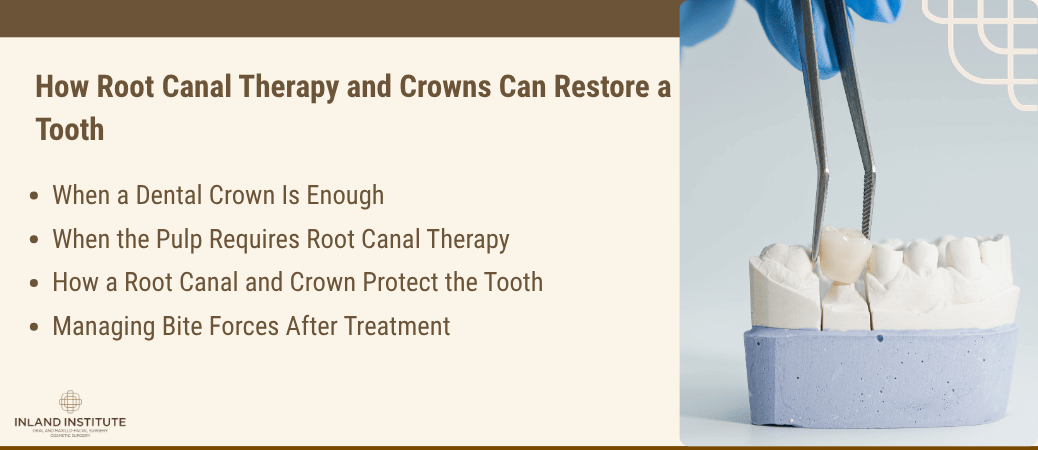
Many cracked teeth can stay in your mouth if the crack stops above the gum line and the root is still solid. The fix might be a crown alone, or a root canal followed by a crown, depending on whether the nerve inside the tooth is involved.
When a Dental Crown Is Enough
If your crack is shallow and the nerve is still healthy, a dental crown may be all you need. The crown wraps around the tooth like a helmet and holds the pieces together when you chew.
This is common with cracked cusps and teeth that have big old fillings. You may feel a sharp twinge when you bite down, but no lingering ache.
A crown and a root canal solve different problems, so you will not always need both. Your dentist may test the tooth with cold and gentle pressure first.
Sometimes a crown calms the tooth down and nothing else is needed. Other times symptoms continue, and the nerve gets treated later.
When the Pulp Requires Root Canal Therapy
Once the crack reaches the pulp, the soft tissue with the nerve and blood vessels, a crown by itself will not stop the pain.
Signs that point toward root canal therapy include:
- Throbbing that lasts minutes after you drink something cold
- Pain that wakes you up at night
- Swelling or a bad taste near the tooth
- Tenderness when you tap the tooth
A cracked tooth can often be saved with a root canal when the crack reaches the pulp but stops short of the root tip. Your dentist or endodontist will also check whether the crack runs vertically down the root, since a split root usually cannot be repaired.
How a Root Canal and Crown Protect the Tooth
The two treatments work as a team. During a root canal, the inflamed or infected pulp is removed, the inside of the tooth is cleaned and disinfected, then sealed with a filling material.
That clears up the infection, but it leaves the tooth hollowed out and easier to break. The crown restores the chewing surface and keeps the crack from spreading.
Keeping your natural tooth also means the root stays in the bone. The American Association of Endodontists notes that a root canal avoids the extra work of replacing a tooth with a bridge or implant later on.
Saving a tooth this way usually costs less over time, too. A root canal with a crown often runs $1,500 to $3,000, while pulling the tooth and adding an implant can total much more.
Managing Bite Forces After Treatment
Your back teeth handle a lot of pressure every day, and that pressure is what made the crack grow in the first place. So the last step is checking your bite balance.
Your dentist will have you tap and grind on thin marking paper, then smooth any high spots on the new crown. A crown that sits even slightly tall keeps taking extra force.
Other ways to lower bite forces on a repaired tooth:
- Wear a night guard if you grind or clench
- Skip ice, hard candy, popcorn kernels, and pens
- Chew tougher foods on the other side for a few weeks
- Come back if the tooth feels sore or "off" when biting
With the root in place and the bite adjusted, a treated tooth usually returns to normal chewing and your other teeth stay where they belong.
When Tooth Extraction Is the Safer Choice
Sometimes a cracked tooth is too damaged to hold together, and keeping it causes more harm than removing it. The location of the crack, the health of the bone around it, and how long you wait all shape that decision.
Cracks That Extend Into the Root or Bone
Position matters more than size. A crack that stops above the gum line can often be covered with a crown, but one that travels below it is a different story.
When a fracture reaches the gum line and root, bacteria settle into the gap and infection follows. There's no filling or crown that seals that space.
A vertical root fracture is the clearest example. It starts in the root and moves upward, and it often shows up years after a root canal. Dentists describe it as not saveable because the crack acts as a permanent path for bacteria.
A split tooth, where the crack has separated the tooth into two pieces, usually ends the same way. Occasionally a molar can be partly saved by removing one root, but that's uncommon.
Severe Infection, Mobility, or Poor Prognosis
Your dentist also looks at what's happening around the tooth, not just the crack itself.
Warning signs that point toward extraction include:
- An abscess that keeps coming back after treatment
- Bone loss that leaves too little support to anchor the tooth
- Mobility, a tooth that wiggles when you press on it
- Too little healthy structure left to hold a crown
Dentists weigh bone support and infection risk alongside how long a repair is likely to last. Some describe it as a savability scorecard: can the tooth be rebuilt, and will that repair hold up for years?
If the answer is no, spending money on a root canal and crown only delays the same outcome.
Why Delaying Care Can Lead to Tooth Loss
Cracks don't heal, and they tend to spread with everyday chewing.
Timing changes your options in a real way. A tooth that needs only a crown this month may need a root canal later, and a tooth that could have been saved can become one that can't be.
That's often how a treatable crack turns into a split tooth. Pressure keeps pushing the crack deeper until it runs through the entire tooth.
Pain that comes and goes is easy to ignore, especially when it fades for a few days. But a brief sharp zing when you release a bite is a signal worth checking, not waiting out.
Getting evaluated early usually means a simpler, less expensive fix.
Planning Tooth Replacement Before Extraction
Talk about what replaces the tooth before it comes out, not after.
Losing a tooth affects more than your smile. Understanding how dental implants can replace missing teeth can help you plan ahead, especially since the bone under the gap can shrink over time and nearby teeth may drift into the open space
Your main choices are:
| Option | What It Involves |
|---|---|
| Dental implant | A titanium post placed in the bone, topped with a crown |
| Bridge | A false tooth anchored to the teeth on either side |
| Partial denture | A removable piece that fills one or more gaps |
Comparing costs, risks, and replacement choices ahead of time helps you budget and avoid surprises.
Ask your dentist whether a bone graft at the time of extraction would make an implant easier later. It's a small step that can protect your options.
Replacement Options and Long-Term Planning
If your tooth can't be saved, the next step is deciding how to fill the gap it leaves behind. Your choices usually come down to a dental implant, a bridge, or a partial denture, and each one affects your bite, your budget, and your long-term oral health in different ways.

Dental Implants and Bone Grafting
A dental implant is a small titanium post placed in your jawbone, topped with a crown. It works a lot like a natural tooth root, so it doesn't rely on the teeth next to it for support.
Implants need enough healthy bone to hold them steady. If bone has shrunk after an infection or a long-standing gap, your dentist may suggest a bone graft first.
Dentists recommend bone grafting, as it adds material to the area and gives it a few months to heal before the implant goes in. Some dentists place a graft right at the time of extraction to keep the socket from collapsing.
The full process often takes several months. Many people accept that timeline because implants can last decades with good brushing, flossing, and checkups.
Bridges and Partial Dentures
A bridge fills a single gap by anchoring a false tooth to the teeth on either side. It's faster than an implant and doesn't need surgery, but the neighboring teeth must be reshaped to hold crowns.
That trade-off matters. Once healthy enamel is removed, those teeth will always need crowns.
A partial denture is a removable option that clips onto your remaining teeth. It costs less up front and can replace several teeth at once, which makes it a practical pick if you're missing more than one tooth.
Partials do move slightly when you chew, and they need nightly cleaning. Your dentist can walk you through implants, bridges, and partial dentures so you can match the option to your daily habits.
Comparing Short-Term Costs With Long-Term Value
The cheapest option today isn't always the cheapest over ten years. Saving a tooth with a root canal and crown often costs less at first than extraction plus an implant, but the long-term cost of each option depends on how much healthy tooth is left and how strong the root is.
Here's a simple way to compare:
| Option | Up-front cost | Typical lifespan | Surgery needed |
|---|---|---|---|
| Root canal + crown | Moderate | Many years with a well-fitted crown | No |
| Implant + crown | Highest | Often decades | Yes |
| Bridge | Moderate | Around 10–15 years | No |
| Partial denture | Lowest | 5–10 years, needs relining | No |
Skipping replacement has its own price. Nearby teeth can drift, your bite balance can shift, and bone in the empty area slowly thins.
That's why replacement planning starts before the tooth comes out, not after.
Questions to Ask Before Choosing Treatment
Bring a short list to your appointment. Clear answers make the decision easier.
- How much healthy tooth structure is left, and is the root cracked? This drives whether saving the tooth is realistic.
- What's the honest prognosis if we try to save it? Ask about the odds and what happens if it fails.
- How long will the whole process take, start to finish?
- Will I need a bone graft, and why?
- How will this affect my bite and the teeth around it?
- What does my insurance cover, and what's my out-of-pocket total?
At Inland Institute Oral & Maxillofacial Surgery, the team evaluates the condition of the tooth, surrounding bone, and nearby structures before recommending treatment. Dr. David Gilbert can explain whether extraction is appropriate and, if the tooth cannot be saved, discuss options for replacing it and preserving the area for your long-term oral health.
Frequently Asked Questions
Most cracked teeth can be saved with a crown or a root canal, and extraction is usually the last step when a crack splits the tooth or runs down into the root. Below are straight answers about how dentists sort out which path fits your tooth, what each option costs, and who does the work.
Do cracked teeth always need to be extracted?
No. Many cracks are shallow and can be fixed without pulling anything.
Tiny surface cracks called craze lines sit in the enamel only. They cause no pain and need no treatment at all.
Even bigger cracks often stay above the nerve, which means a crown can hold the tooth together. Dentists agree that not all cracked teeth need extraction, and saving your natural tooth is almost always the first goal.
How does a dentist determine whether a cracked tooth can be saved?
The main question is how deep the crack goes and which direction it travels. A crack that stops above the nerve is very different from one that reaches the root.
Three tools help answer that. A surgical microscope lets the dentist follow the crack line and see where it ends, CBCT 3D imaging shows root fractures and bone loss, and bite testing pinpoints which cusp hurts. Regular X-rays miss most cracks, which is why depth and direction decide the verdict.
Your dentist also looks at how much healthy tooth is left, whether infection is present, and how the tooth lines up with your bite. Those extra factors weigh into the recommendation along with the crack itself.
What treatment options are available for a cracked tooth besides extraction?
There are a few, and they line up with how bad the damage is:
- Bonding for small chips and shallow cracks
- A crown for a fractured cusp or a crack that stays above the nerve
- Root canal plus a crown when the crack reaches the pulp
- Hemisection in rare cases, where one root of a molar is removed and the rest is kept
The right choice depends on the location, size, and severity of the damage. Waiting makes the list shorter, since a crack that only needs a crown today can spread and need more work later.
When is a root canal and crown better than pulling a cracked tooth?
A root canal and crown make sense when the crack has reached the nerve but the tooth still has a solid root and enough structure to support a crown.
Keeping your own tooth protects your bite and your jawbone. Neighboring teeth also stay put instead of drifting into an empty space. Extraction becomes the better call when the tooth is split in two or the crack starts in the root.
Can a regular dentist extract a badly broken or cracked tooth?
Often, yes. General dentists handle plenty of simple extractions right in their own office.
Some cases get referred to an oral surgeon instead. That usually happens when the tooth has broken off at the gumline, the roots are curved, or the tooth sits close to a nerve or sinus.
Either way, the visit starts with an exam and imaging so nothing is a surprise. Your dentist should walk you through the crown versus extraction choice before any work begins.
How much does cracked tooth repair cost compared with extraction?
Repair usually costs less up front than replacing the tooth later. Here are typical ranges:
| Treatment | Typical cost |
|---|---|
| Craze lines | $0 (no treatment) |
| Crown only | $1,200–$1,800 |
| Root canal + crown | $2,100–$3,500 |
| Extraction | $200–$600 |
| Extraction + implant | $4,000–$6,000+ |
Pulling the tooth looks cheap on its own, but the bill grows once you add a bridge or implant. That is why catching a crack early keeps both your options and your costs more manageable.